Do you celebrate the people who organize lunches on your team?
You should. They might be your most important innovators.
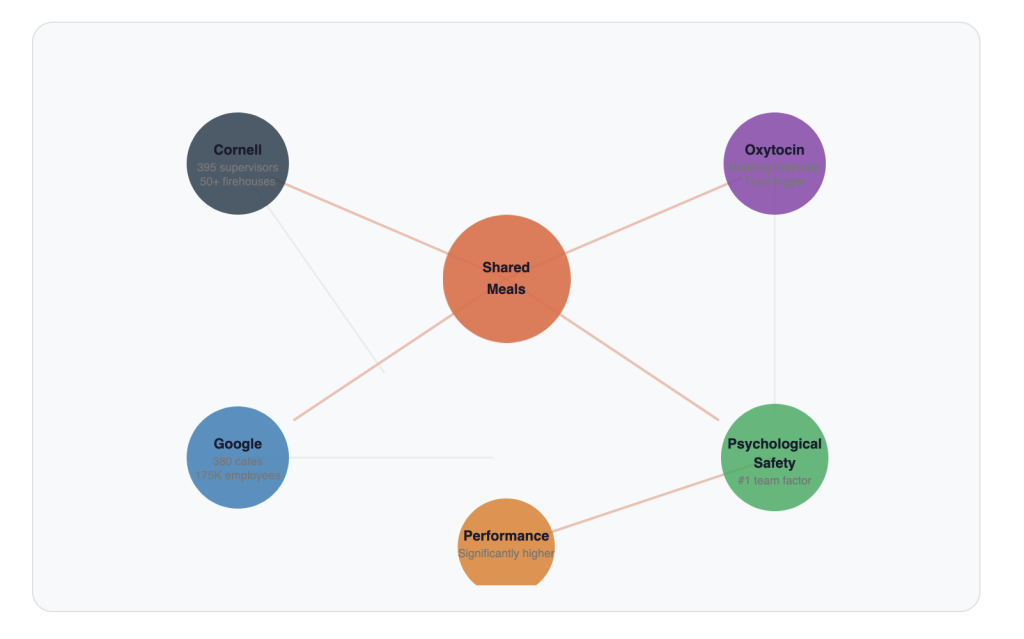
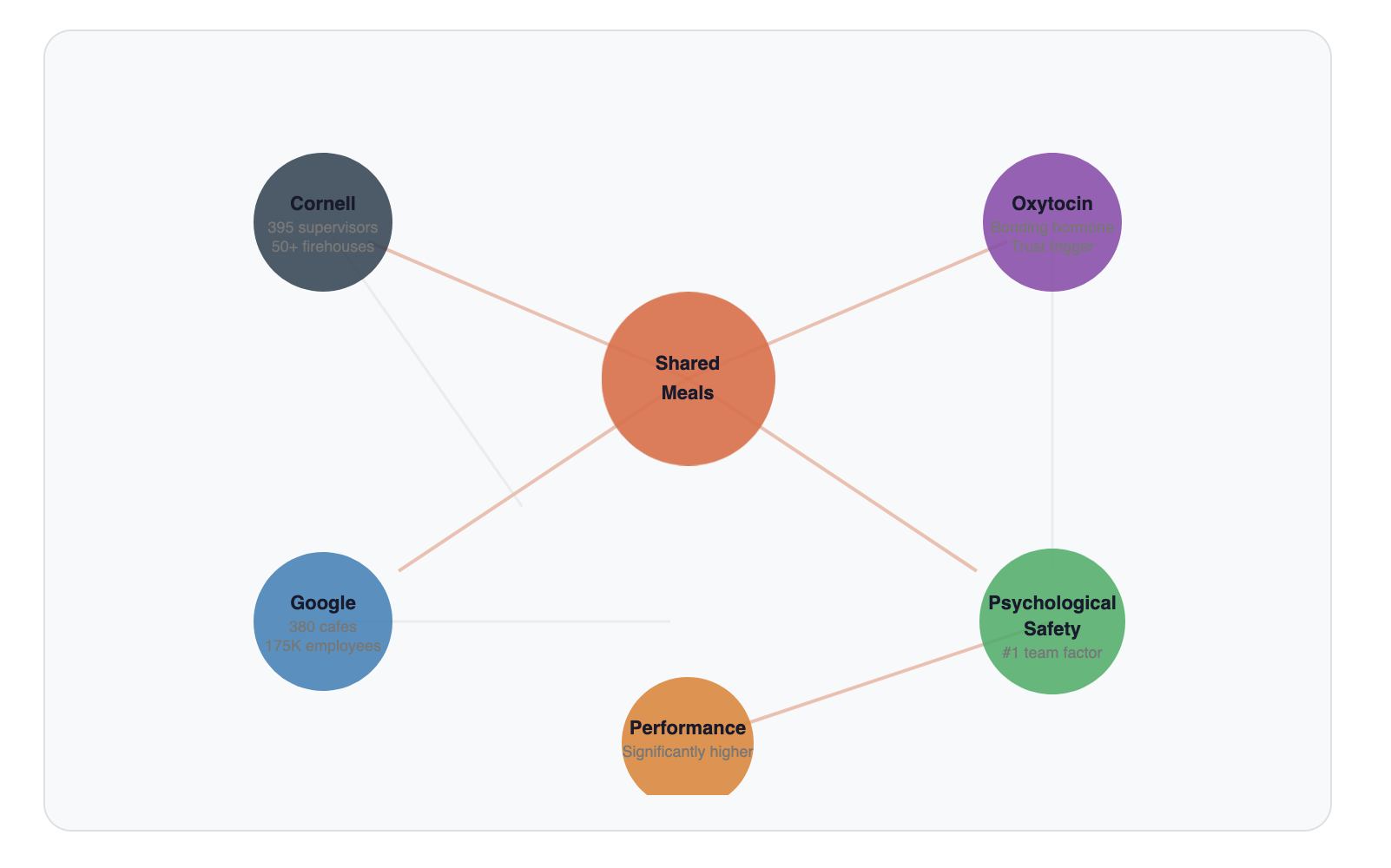
Google’s Project Aristotle studied 180+ teams and found the #1 factor in team effectiveness isn’t talent or experience. It’s psychological safety: the feeling that you can be yourself without getting judged. And shared meals are one of the most reliable ways to build it. Cornell researchers confirmed it. Gallup quantified it. The data is clear: the person organizing Thursday lunch may be doing more for your team’s performance than your last $50,000 software purchase.
For innovation leaders, this matters. Your biggest culture investment might not need a budget. It needs a person who gives a damn.
Eat Together = Perform Better
Here’s how the research connects. Every arrow below is a peer-reviewed finding:
 395
Researcher Kevin Kniffin called eating together “a more intimate task than just looking over an Excel spreadsheet.” That intimacy spills directly into how teams coordinate under pressure.
The mechanism is biological. Shared meals trigger oxytocin release: the same bonding hormone involved in parent-child attachment. People who eat similar foods show significantly higher trust and reach agreements faster in negotiations. People eating from shared portions earned more money in simulated labor negotiations than those eating from individual plates.
Simple Rituals vs Corporate Programs
The numbers here should make anyone with a six-figure “culture budget” a little uncomfortable.
| The “Initiative” | Cost | Actual Impact | How Long It Lasts |
|---|---|---|---|
| Corporate retreat | $500-1K/person/night | “Adrenaline shot” that wears off (HBR’s words, not mine) | 2 weeks, tops |
| Engagement software | $5K-50K/year | Global disengagement still costs $8.8 trillion | Until the renewal invoice |
| Team-building ropes course | $10K+ one day | Trust falls that create trust issues (if you’ve done one, you know) | One awkward afternoon |
| Sushi Thursday (Gina’s way) | $25/person | Psychological safety + oxytocin + actual human connection | Every. Single. Week. |
Jacob Morgan, Harvard Business Review
Harvard Business School researcher Michael Norton found that group bonding activities led to a 16% increase in how meaningful employees judged their work. Not from a retreat. From simple, repeated rituals.
KPMG’s research found that 83% of professionals say their company’s approach to fostering work friendships is important to staying at their job. People don’t leave companies. They leave cultures that don’t connect them.
The pattern: expensive programs create temporary spikes. Daily rituals create lasting culture.
Your Team’s Most Valuable Innovator?
Gina Markoe
Gina isn’t a manager. She doesn’t run “culture initiatives” or have “engagement” anywhere in her title. She doesn’t even try to make it about work.
What she does: every Thursday, she buys sushi ingredients, sets up a station, and invites the whole team to make their own rolls. She coaches people through it. She teaches without a curriculum. She creates a space where learning happens naturally, where conversation flows, and where the team actually wants to show up.
(My rolls turned out edible. Possibly because Gina coached me through it one-handed while I was filming a video at the same time. She’s patient like that.)
And then came the real innovation: the late penalty. Last person to arrive gets their roll loaded with enough wasabi to ruin their afternoon. Not punishment. Accountability. With a sense of humor.
That serendipitous idea turned a nice team lunch into something people actually organize their Thursdays around.
Now. We love to celebrate innovation at famous companies:
- 3M: gave employees 15% time.
Got 22,800 patents. Allegedly. Who counted? - Zappos: built a “culture empire.”
They sold shoes. Really well, to be fair. - Google: spent who-knows-how-much on 380 cafeterias.
It’s Google. They can afford it.
Cool. Good for them.
But Gina bought sushi ingredients. Set up a cutting board. And every Thursday, she does what all those famous programs try to do: she brings people together. She coaches without calling it coaching. She teaches without a lesson plan. She creates serendipity without a framework.
We write case studies about billionaires redesigning buildings. We should be writing them about the Ginas. Because self-organizing collaboration starts with one person deciding to care.
How Do You Build a Ritual That Actually Sticks?
Not all rituals work. The research is honest about this: poorly executed or forced rituals actively damage culture. They reduce engagement, boost turnover, and breed cynicism.
The rituals that stick share four qualities:
- Voluntary.
Gina doesn’t send a calendar invite with “mandatory fun” in the subject line. People show up because they want to. - Consistent.
Every Thursday. Not “whenever we can.” Predictability builds trust. - Inclusive.
Anyone can make sushi. (Badly, in my case, but edible.) Low barrier = high participation. - They have stakes.
The wasabi penalty isn’t cruelty. It’s a shared joke that creates belonging. Inside jokes are culture made visible.
Harvard Business School’s research confirms this. Rituals that emerge organically from the team, rather than imposed from above, create the consistency and camaraderie that endure. You can’t mandate culture. But you can nurture the conditions where it grows.
Usually, those conditions look a lot like someone bringing sushi.
The Innovation Dad Rule
The most effective innovations are often the simplest. A meal. A penalty. A person who cares enough to bring the team together. The research backs it up. Gallup, Cornell, Google, Harvard. The data is overwhelming. And the cost is $25 worth of rice, nori, and wasabi.
The irony of spending billions on AI-powered engagement platforms while ignoring the person who organizes Thursday lunch isn’t lost on me. We’re building tools to measure and optimize culture when the most effective culture-building tool is a $25 sushi station. (I came up with the “Innovation Dad” handle on Instagram because of my three teenage kids. They’re better at innovation than most corporate programs I’ve seen.)
Great teams don’t need more meetings. They need more rituals. And a little wasabi accountability.
FAQ
While we’re here…
Ikujiro Nonaka’s “Ba” concept: The Japanese organizational theorist argues that knowledge creation requires a shared space (“ba”) where relationships emerge. Sushi Thursday is literally creating ba. Innovation management theory backing up a $25 sushi station.
Robin Dunbar (the “Dunbar’s Number” researcher) has studied how social eating triggers endorphin release. His work suggests shared meals may have evolved specifically as a social bonding mechanism. The campfire meal was humanity’s first team ritual.
Military mess halls: Designed for unit cohesion, not nutrition. The military has known for centuries what corporate America is just now researching: eating together builds the trust you need when things get hard.
Want to build teams that actually collaborate?
Explore how Collaboration.AI helps innovation leaders create the conditions for real teamwork. Innosabi for innovation management. NetworkOS for relationship intelligence.