
Brandon Klein · Collaboration.Ai · May 14, 2026
How I’m Actually Going to Use Offset Symposium 2026
Hi, I’m Brandon Klein. I founded Collaboration.Ai. I’m going to the Offset Symposium in DC on May 14. And I’m not going for the panels.
Thursday, May 14, 2026 Andrew W. Mellon Auditorium, DC Register
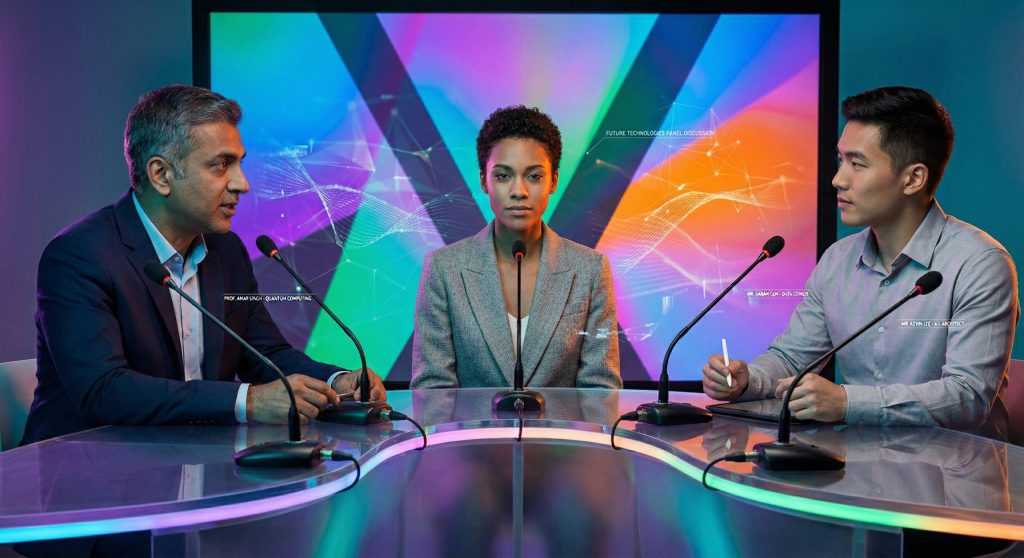
Panels haven’t changed in thousands of years. Seriously. The format of “important people talk at seated audience” is as old as the Roman Senate. I’ve spent 15 years writing about better ways to do this. I even declared the end of panel discussions on our blog. Nobody listened.
So I stopped trying to fix the format. Instead, I fixed how I attend. Here’s the math that changed my approach, and the playbook I’m using at Offset.
My Playbook for May 14
I don’t think panels are the enemy. Passivity is. Here’s exactly what I’m doing at Offset, and what you can steal for any conference.
I’m pre-mapping my 5
Before I fly to DC, I’m picking the 5 people I need to meet. Not “would be nice.” Need. I’m running them through NetworkOS, our relationship intelligence platform, to find overlapping connections, shared interests, and the right conversation openers. You can do the same thing with 20 minutes of LinkedIn research. The point: walk in with a target list, not a hope.
Skip one panel. Just one.
You don’t have to go rogue. Just skip one. Take that 45 minutes and stand near the coffee station. You’ll meet more decision-makers in that window than you will in any Q&A line. The hallway is the real conference. Always has been.
Lead with what you can give
“What do you do?” is a dead conversation. I open with: “I noticed your company is working on [X]. I know someone you should talk to.” Connectors win conferences. Self-promoters get forgotten by baggage claim. I’ve been building frameworks for this since I ran networking experiments at TechCrunch.
Follow up before you fly home
That night. Not next Monday. Send a two-sentence LinkedIn message while the face is fresh. “Great talking about [specific thing]. Here’s that intro I mentioned.” 48 hours later, you’re already a stranger again.
Skip all panels. Watch the recordings later.
Here’s the advanced move: most conferences record everything now. You’ll get the summary customized to your interests afterward. So spend the entire day in conversations. If you have one real question for a specific speaker, go. But sit right next to the microphone so you don’t waste 10 minutes waiting in line. Get in, ask, get out, get back to connecting.
Advanced
Hack your name tag
Conference name tags are terrible. They show your name and company. Nobody cares. I bring a Scout notebook and write a different tag: what I’m looking for and what I can offer. “Building AI for defense innovation teams. Looking for: DoD program managers who hate their current tools.” That one sentence starts more conversations than your title ever will. I wrote about better ways to break the ice years ago. Still works.
Pro move
Who’s on Stage (and Why You Should Meet Them Off Stage)
I ran deep research on every speaker. Not their LinkedIn headline. What they’re actually working on right now, what they’ve said publicly in the last six months, and the one question worth asking them in person. Not from row 14.
Type a topic, technology, or goal. Matching speakers rise to the top.
What he’s building
Second Front fast-tracks commercial software into government networks through Game Warden, their DevSecOps platform. Under Sweatt’s leadership, Game Warden hit FedRAMP High authorization (August 2025) and became the first authorized platform on AWS Marketplace under the DoD JWCC contract (February 2026). He was elevated to Board Chairman in September 2025, with former CIA CTO Nand Mulchandani joining the board.
Recent activity
Game Warden Becomes First on AWS Marketplace for DoD JWCC BusinessWire, Feb 2026 Adds Former CIA CTO to Board, Sweatt Named Chairman Second Front, Sep 2025 Raises $70M Series C Led by Salesforce Ventures PRNewswire, Sep 2024
Ask him: With Game Warden now the primary on-ramp for commercial software into DoD networks, how are you managing the influx of vendors seeking accreditation? And how do you balance platform openness with software quality?
What he’s building
Gibian is the warfighting lead at the CDAO, architecting the DoD’s 2026 AI acceleration strategy. He’s overseeing seven “Pace-Setting Projects” including Swarm Forge (competitive AI swarm development), Agent Network (AI battle management agents), Ender’s Foundry (AI simulation), and GenAI.mil, which gives the entire Department access to frontier generative AI models. His core thesis: speed and iteration cycle time are the decisive variables in modern warfare.
Recent activity
DoD AI Strategy for the Department of War Defense.gov, Jan 2026 GenAI.mil Makes Debut as DoD Pushes Commercial AI at Scale GovCIO, 2026
Ask him: With GenAI.mil giving the whole Department access to frontier models, how should private defense tech companies position their differentiation? Is it proprietary AI, domain-specific integration, or speed-to-deployment?
What he’s building
Cohere builds enterprise AI foundation models with a focus on security, privacy, and multilingual capability. They hit $240M in annual recurring revenue in 2025 with 50%+ quarter-over-quarter growth. In February 2026, they launched Tiny Aya: open-weight models supporting 70+ languages that run on consumer laptops without internet. That’s significant for defense: air-gapped, disconnected operations with local AI inference.
Recent activity
Cohere Launches Family of Open Multilingual Models TechCrunch, Feb 2026 Open-Sources Tiny Aya 70-Language AI Models AI2 Work, Feb 2026 Ivan Zhang on the Real-World Benefits of AI The Peak, 2024
Ask him: Tiny Aya runs locally without internet. For defense applications in disconnected environments, what are the inference speed tradeoffs vs. your larger models? And how do you handle model updates when there’s no network?
What he’s building
Armada builds modular, ruggedized AI data centers (“Galleons”) that operate independently from cloud infrastructure. Full-stack edge: hardware from suitcase to megawatt-scale, the Armada Edge Platform software, and pre-configured Starlink connectivity. They just opened their first Galleon Experience Center with Carahsoft in Reston, VA (April 2026). Recent partnerships with Microsoft Azure Local and OpenAI for edge-optimized AI models.
Recent activity
Opens First Galleon Experience Center with Carahsoft GlobeNewswire, Apr 2026 AI at the Edge: Taking Compute Everywhere the Cloud Can’t Go GTMnow, 2026 The New Edge (Podcast) Payload
Ask him: Your Galleons combine compute, connectivity, and AI but need serious power. What’s the minimum power requirement for a tactically deployable unit, and how do you balance capability density with deployment speed to truly remote locations?
What he’s building
Forterra builds autonomous mission systems for defense: self-driving land vehicles and coordinated robotic swarms. They hit unicorn status in November 2025 after a $238M Series C. Currently partnering with BAE Systems on an autonomous Armored Multi-Purpose Vehicle (AMPV) with delivery target of May 2026. Just acquired goTenna to advance autonomous comms, and expanded their Arlington HQ to get closer to the Pentagon.
Recent activity
Autonomous Military Vehicle Company Aims to Cozy Up to Pentagon Washington Times, Feb 2026 BAE Systems, Forterra Join Forces for Autonomous AMPV Breaking Defense, Sep 2025
Ask him: How are you managing integration complexity across different vehicle types (AMPV, Bradley, M109A7) while keeping military-grade reliability? And what did the goTenna acquisition unlock for comms?
What he’s building
Andesite builds AI-powered human-AI collaboration tools for defense cyber operations. Carbaugh is a former Director of the CIA’s Special Activities Center with 20+ years in intelligence. In February 2025, he launched the “Bionic SOC” (Security Operations Center): context-aware AI that unifies scattered data across organizational silos with complete auditability. Raised $38.25M from General Catalyst and Red Cell Partners.
Recent activity
How Lessons from the CIA Can Power an AI-Powered SOC CyberScoop, 2025 Raises $23M and Announces General Availability of Bionic SOC GlobeNewswire, Feb 2025
Ask him: What specific decision workflows from your CIA career proved most critical when designing human-AI collaboration for cybersecurity teams? Where does the AI defer to the human, and why?
What he’s building
Aalyria combines Spacetime (intelligent network orchestration software) with Tightbeam (free-space laser communications), originally from Google and Lawrence Livermore National Lab. Valued at $1.3B after a $100M Series B in February 2026. Their tech orchestrates complex networks across land, sea, air, and space. Currently deployed with Telesat’s LEO constellation and Rivada Space Networks, plus multiple U.S. military services.
Recent activity
Hits $1.3B Valuation After Satellite Mesh Network Raise SpaceNews, Feb 2026 Raises $100M for Laser-Powered Space Network Data Center Dynamics, Feb 2026
Ask him: How does Spacetime’s orchestration adapt routing when laser links degrade in bad weather? And what are the operational constraints military users should expect for Tightbeam in contested environments?
What he’s focused on
Former Army intelligence officer with two combat tours in Iraq. Co-founded the House Defense Modernization Caucus with Rep. Wittman. Pushing hard on acquisition reform, software-centric military approaches, and removing barriers for non-traditional defense contractors. Secured provisions in the 2026 NDAA for counter-UAS capabilities and small company defense contracting.
Recent activity
Defense Modernization Caucus Touts Key Reforms in 2026 NDAA DefenseScoop, Dec 2025 Caucus Delivers Critical Defense Innovations Official Press Release, 2025
Ask him: What specific procurement changes in the 2026 NDAA would most accelerate adoption of edge AI and distributed compute? And how do small companies actually navigate the new pathways?
What he’s focused on
Vice Chairman of the House Armed Services Committee and Chair of Tactical Air and Land Forces. Oversees the largest modernization portfolio on the committee: ground forces, air assets, munitions. Co-chair of the Congressional Shipbuilding Caucus. Currently pushing for defense “right to repair” policies and private equity investment through the Office of Strategic Capital to accelerate defense R&D.
Recent activity
On Army Modernization, DoD Relations and Right to Repair Breaking Defense, Mar 2026 NDAA on Track for Mid-December Breaking Defense, Nov 2025 The Future of U.S. Naval Power (Full Transcript) Hudson Institute
Ask him: You’ve championed “right to repair” in defense. How does that framework apply to edge AI systems on ships and tactical platforms where supply chain sovereignty is critical?
What he’s building
25 years in national security (Air Force Intelligence CIO, White House, Special Ops) before leading AWS’s DoD cloud innovation. Currently driving edge computing demos, AI foundation model authorizations (Claude, Llama now approved for FedRAMP High and DoD IL-4/5), and classified cloud expansion. His vision: warfighters self-provisioning AI-powered solutions within 24 hours as routine by 2027.
Recent activity
Demonstrates Resilient Edge-to-Cloud at DoD Exercise AWS Public Sector Blog, 2025 Bedrock Models Get FedRAMP High and DoD IL-4/5 Approval AWS Public Sector Blog, 2025
Ask him: What’s AWS’s roadmap for bringing AI models to the tactical edge without sacrificing security? And how do you balance rapid innovation cycles with DoD’s certification timeline?
What he’s building
Onebrief is military planning and collaboration software that fuses AI workflows, decision intelligence, and collaborative tools into one platform. They raised $200M at a $2.15B valuation in their Series D (2026) and acquired Battle Road Digital. Their AI co-planner is in testing, targeting a 100x productivity increase in military planning over three years. Currently supports planning from tactical echelons to the Pentagon and White House.
Recent activity
Secretary Hegseth Pushing Software Innovation to Win Our Next War Nov 2025 Secures $53M to Build the Future of Military Staffs Onebrief, Mar 2025
Ask him: How are you integrating AI co-planning without creating single points of failure in contested environments? What safeguards prevent over-reliance on algorithmic recommendations during actual operations?
What he’s focused on
Gray leads market development at Second Front, driving strategic partnerships and government relationships. He’s been tracking the Navy’s consolidation of 66 unmanned programs under a single command and advocating for streamlined software delivery across defense. Recently shifted to VP of Strategic Engagement, focusing on the growing ecosystem of companies building on Game Warden.
Recent activity
Partners with Saab to Deliver Software to Remote Environments PRNewswire, 2025 Powering Software for the Free World (Podcast) Second Front, 2025
Ask him: What are the biggest barriers stopping commercial SaaS vendors from getting security accreditation faster? And how does Game Warden’s model expand beyond software platforms?
What he covers
Demarest produces the weekly Axios “Future of Defense” newsletter and tracks defense tech, military innovation, VC capital flow, and Pentagon acquisition strategy. 6+ years covering defense across C4ISRNET and other outlets. Currently tracking what he calls an “absolute avalanche of private capital” into defense tech and whether it signals a bubble or a structural shift.
Recent coverage
The Booms and Bombs of Defense-Tech Investing Axios, Jul 2025 Vector Raises $61M with “Modern Warfare as a Service” Axios, Sep 2025 Booz Allen Eyeing These 4 Defense-Tech Fields for Investment Axios, Oct 2025
Ask him: You’ve documented the flood of VC into defense tech. What early warning signals distinguish sustainable companies from bubble plays? And what story are you most looking for right now?
Meet Me at the Coffee Station
I founded Collaboration.Ai because I believe helping innovators find each other is the most important work in our industry. That’s what we do. We help others, including ourselves, improve how innovation actually happens.
Before the event, I’m running analyses on the attendees, the speakers, and the problems across the defense innovation market using NetworkOS. I want to know who needs what. So when you find me at the coffee station, I won’t ask “what do you do?” I’ll tell you who you should meet and why.
Skip the Q&A line. Come get a coffee. I’ll make an intro that’s worth more than any panel answer.
I’ve Been Saying This for Thousands of Years
Well, 15 of them. Panels haven’t changed since the Roman Senate. I’ve been trying to fix them since 2007. Here’s the trail of evidence, plus some people and organizations trying to make conferences less terrible.
From the Collaboration. Ai Blog
A Guide to Better Panel Discussions Fishbowl formats, Kotter groups, cocktail seating The End of “Panel Discussions” Why the format needs to die (it didn’t listen) Take-A-Panel Exercise How to give everyone a voice, not just the stage 5 Steps to Impactful Conference Relationships Data-driven networking at TechCrunch Wow, It’s Great to Meet You! Better icebreakers than “what do you do?” Networking Quick Connectors Exercises that connect people in under 5 minutes
Others Trying to Fix Conferences
Innov8rs Unconference Cross-industry innovation leaders building peer-driven formats. No slides, no panels. InnoLead IMPACT Conference Bans PowerPoints. Safe, off-the-record sharing between corporate innovators. An Open Letter to Innovators Why Collaboration.Ai exists and what we’re building toward NetworkOS Our relationship intelligence platform. The tool behind the playbook. AI-Powered Workshops How design leaders are transforming team innovation with new tools


