
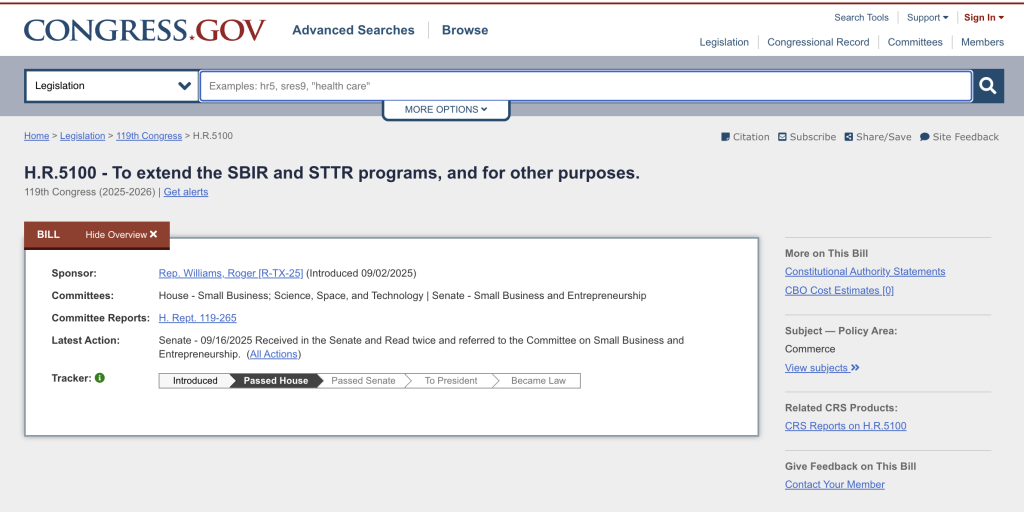
TLDR: Congress just dropped a bill that extends SBIR funding through 2031, creates $30M “strategic breakthrough” awards, and cuts the red tape that kills small innovators. If you build things that matter, this is your moment.
In 2017, we got our first SBIR. That single award changed everything for Collaboration.Ai. It validated the idea that small companies could solve problems the big primes couldn’t. It opened doors to AFWERX, the DAF Digital Transformation Office, USSOCOM, NASA, and more.
This bill is personal. The Small Business Innovation and Economic Security Act has been introduced by Senators Joni Ernst (R-IA) and Ed Markey (D-MA) and referred to committee. It reauthorizes SBIR and STTR through 2031. It creates “strategic breakthrough” awards worth up to $30 million. And it cuts the paperwork that stops good ideas from becoming real products.
I’ve lived this pipeline for almost a decade now. Here’s what’s in the bill and why it matters.
$4B+
Annual SBIR/STTR funding available to small businesses across 11 federal agencies. This bill keeps it alive through 2031.
What’s Actually in This Bill? (The Real Version)
I read all 40 pages so you don’t have to. Here’s what matters.
How the Bill’s 10 Sections Connect
Three pillars: more money, less bureaucracy, stronger safeguards.
Strategic Breakthrough Awards = Real Scale Money
This is the headline. The bill creates a brand new category of SBIR funding that didn’t exist before. Agencies with $100M+ in SBIR budgets must set aside 0.5% for “strategic breakthrough” awards. The ceiling? $30 million per company.
$30M Maximum per company under the new Phase II Strategic Breakthrough Funding. 48-month performance period. 100% matching funds required. 90-day contracting deadline.
For context: today’s typical Phase I awards run about $150K for initial feasibility. Phase II development tops out around $1M. This new strategic breakthrough category jumps to $30M. That’s a different universe. The kind of money that turns a prototype into a product line. The kind that creates jobs in your town, not just papers in a journal.
And the matching requirement? Smart. It means you can’t just collect government checks. You’ve got to have skin in the game. Investors, customers, partners. The government says: “We believe in you. Now prove someone else does too.”
If you aren’t happy with current politics, equity, work, planet, don’t just sit there. We need people to step up and start the change. This bill is Washington actually stepping up. Brandon Klein
The Phase III Problem (Finally Getting Fixed)
Ask any SBIR veteran their biggest frustration. It’s Phase III. You build an incredible technology with government funding. Then you try to sell it back to the government. And the contracting officers? They know what SBIR is. But most don’t know how to use Phase III authorities to actually buy from you. As an innovator, you’ve done the hard part. The system just doesn’t know how to meet you at the finish line.
The bill attacks this head-on:
| Phase III Problem | Before This Bill | After This Bill |
|---|---|---|
| Contracting officers don’t know how to use SBIR | Tough luck | Mandatory workforce training on Phase III |
| Procurement reps ignore small biz | No accountability | New directives from procurement center reps |
| Complex contracts kill small teams | Case by case | Standardized, simplified contracts |
| No one tracks Phase III outcomes | Data black hole | Federal procurement system must tag SBIR awards |
I’ve seen this problem firsthand. Collaboration.Ai has held a 5-year contract with AFWERX. We’ve supported 50+ challenges including Base of the Future after Hurricane Michael destroyed Tyndall AFB. We won a $10M contract with SOCOM. The talent is there. The technology is there. The bottleneck? Almost always the contracting process. This bill takes a sledgehammer to that bottleneck.
Security Without Strangling Innovation
The bill includes a “don’t give SBIR money to adversaries” provision. It’s overdue.
The bill requires agencies to screen SBIR applicants against the UFLPA Entity List, Chinese Military Companies list, and Section 889 Prohibition List. If you’re connected to foreign entities developing technology for adversaries, you don’t get funded. Period.
But here’s the nuance that matters: denied applicants get notified and can appeal. The screening checks for potential foreign involvement in technology development or commercialization. It’s not a witch hunt. It’s due diligence. If you’re an American innovator playing by the rules, this protects you from competing against companies that aren’t.
Less Paperwork, More Building
The bill caps how many proposals agencies can demand per topic. That sounds boring. It’s not. Here’s why.
Small teams spend months writing proposals. Every page they write is a page they’re not building. The current system rewards proposal-writing skill, not innovation skill. Those are very different things.
5% Maximum topics that can receive a waiver from proposal page limits. Agencies can still request longer proposals in special cases, but they can’t make it the default. Less writing, more building.
There’s another relief valve: small businesses can now pick their own technical assistance providers. No more being forced into a vendor you didn’t choose. Phase I awardees get up to $6,500 for technical help. Phase II: up to $50,000. And for the first time, cybersecurity assistance is explicitly included.
I-Corps and Commercialization Training
The bill mandates I-Corps participation options for SBIR/STTR awardees. I-Corps (Innovation Corps) is a bootcamp for turning research into business. Customer discovery, market validation, go-to-market strategy.
The funding can come from I-Corps grants, SBIR award funds, or agency technical assistance budgets. The point: you built something in the lab. Now learn how to sell it.
This connects to what we do at Collaboration.Ai. Our NetworkOS platform maps the relationships and intelligence you need to commercialize ideas. SBIR has the funding. I-Corps has the curriculum. What’s been missing is the relationship intelligence. That’s the gap we fill.
Why This Matters Right Now (The AI Angle)
AI can amplify a 5-person team to perform like a 50-person company. I’ve seen it. My 12-year-old uses AI tools that didn’t exist two years ago. We helped kick off Agility Prime, the program that brought flying cars from science fiction to Air Force flight tests. We ran a workshop with 701 AI agents supporting human participants. The technology moves at a pace that makes traditional government timelines look absurd.
This bill gives small AI companies something they need: runway. Six years of guaranteed authorization. Strategic breakthrough awards that fund real development, not just demos. Cybersecurity support baked into technical assistance. And simplified contracting so you can actually sell your AI product to the government that funded it.
Think AI is here to take your job? Think bigger. The real question is whether small innovators get the tools to lead that change or get crushed by it. Brandon Klein, LinkedIn, October 2024
McKinsey estimates that activities accounting for up to 30% of hours worked across the U.S. economy could be automated by 2030. That’s not a scare tactic. That’s the world we’re walking into. The question isn’t whether AI will change the economy. It’s whether small innovators get the tools to lead that change or get crushed by it.
I Believe It’s All of Our Civic Role to Support Innovators
I’ve been saying this for years: collaboration at scale is the only way we solve what’s in front of us. Healthcare. Education. National security. No single company, no single agency, no single genius solves these alone.
The SBIR program is one of the few mechanisms where government says: “We trust small businesses to solve hard problems.” This bill strengthens that trust. It extends it. It scales it.
But here’s the part Congress can’t legislate: you’ve got to show up. You’ve got to apply. You’ve got to build the thing. And then you’ve got to fight through the Phase III contracting maze (which this bill makes easier, but won’t make effortless).
That’s the new civic role. Not just voting. Not just complaining. Building. Hiring. Innovating in your community with federal backing. That’s how you create jobs in Minnesota, in Tulsa, in Boise, in places that Silicon Valley forgot.
FAQ
What is the SBIR Bill 2026?
The “Small Business Innovation and Economic Security Act,” introduced by Senators Ernst and Markey. It reauthorizes SBIR/STTR programs through September 30, 2031. It adds strategic breakthrough funding up to $30M, reduces administrative burden, and strengthens security screening for foreign entities.
How much can my small business get?
Phase I awards remain around $150K-$250K. Phase II is typically $750K-$1M. The new strategic breakthrough awards go up to $30M per company with 100% matching and a 48-month timeline. Technical assistance adds $6,500 (Phase I) or $50,000 (Phase II) per project.
Does this help AI companies specifically?
Yes. The bill adds cybersecurity assistance to technical support, lets companies choose their own vendors, and extends all 11 participating agencies through 2031. DOE, NASA, and DoD are all major AI funders through SBIR. The strategic breakthrough awards are designed for exactly the kind of high-impact AI work small companies do.
How does this connect to innovation management?
SBIR is the largest innovation management program in the federal government. It’s also the most decentralized, running across 11 agencies with different rules and processes. Tools like Collaboration.Ai’s NetworkOS help small businesses navigate these relationships and find the right opportunities. This bill makes the program more navigable, but you still need the intelligence layer to find your path.
I’ve never applied for SBIR. Where do I start?
Start at SBIR.gov. Find topics that match your technology. Talk to the agency program managers (they want to help). Consider I-Corps training to validate your market. And don’t try to go it alone: the relationship intelligence and mentorship ecosystem around SBIR is as valuable as the funding itself.
Ready to Navigate the Government Innovation Ecosystem?
Collaboration.Ai helps innovators map relationships, find opportunities, and build the connections that turn funded research into real products. We’ve done it with the US Air Force, PwC, and the World Bank.
While we’re here…
Senator Joni Ernst isn’t just signing legislation. She’s from Iowa, where small manufacturers live or die by federal R&D pathways. Her co-sponsor Ed Markey championed the original SBIR reauthorization in 2011. This bipartisan pairing is rare and strategic.
Pattern: The I-Corps provision mirrors what we’ve seen work at Collaboration.Ai: the best innovation happens when you pair funding with relationship intelligence and customer discovery. Money alone doesn’t commercialize. People do.
SBIR angle: Over 214,000 SBIR awards have been made since the program’s inception. This bill doesn’t just extend the program. It restructures how those awards become products and jobs. That’s a different ambition entirely.


