
Collaboration.Ai has led networking at thousands of events and now dozen of large virtual events.
Overall:
- Overall, we try to remain platform agnostic so that we can choose the best solutions for any given client or event vs. being tied into a small group of technologies. Of course, our own software powers much of what we do, but doesn’t always fit into the transitional virtual event tech stack.
- There are some platforms that offer a somewhat all-in-one experience (Whova, Pathable, On24, etc.) and we have supported clients with those tools, but we tend to see issues with accessibility, limitations in specific areas, and extremely high-costs. With that, we lean towards using best-in-class technology that is easy to use for the end user.
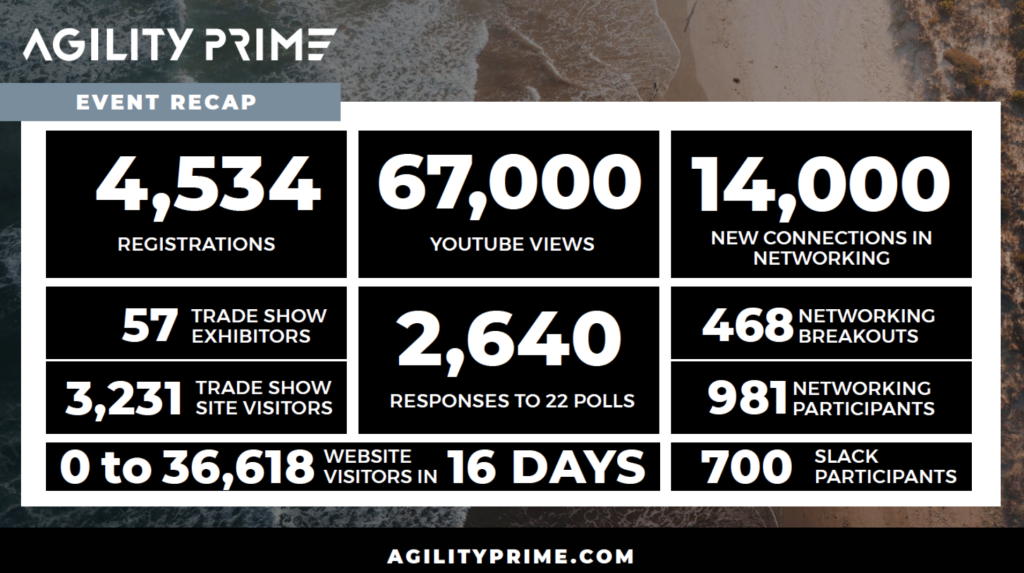
- As appealing as a single-sign on might seem, we haven’t seen it done in a way that makes every step of the process work smoothly. Our recommendation on this is to build something into your existing site or a custom site where you can easily change content, embed streaming, etc. This allows you to control everything – as examples of this, we hosted the entire Agility Prime (70,000 attendees) event embedded in their site and we are doing the same thing for AFWERX Fusion.
Registration:
- Because of the niche requirements of registration software, we typically leverage one of the established platforms – Eventbrite, Aventri, Hubspot, Trippus, etc.
- While this doesn’t tie directly into the event, you can use registration to limit communications, share links with passwords, etc. only to registered users.
Streaming/Content:
- Our standard platform for streaming content (speakers, panels, etc.) is YouTube Live. It is easy to access, inexpensive, and has all the features that viewers expect. The big downside is that it isn’t password protected – if that is a requirement (i.e. you are streaming confidential information or want to charge for attendance), you need to look at alternatives.
- Other streaming options include Vimeo, Twitch, DaCast, and Discord – all of which have pros and cons.
Engagement Sessions:
- We almost exclusively use Zoom based on stability, ease of use, and features.
- Other platforms include WebEx, Teams, and Google Meet and there are some niche technologies available depending on your goals.
- Depending on content and goals, we either set up open Zoom Meetings (i.e. we want as many people to come from the main event into an engagement session) or we can limit attendance by requiring a password or setting a limit on the number of attendees.
Resource Library:
- This is something that isn’t typically part of our virtual events, but is definitely something easily integrated. There are several ways to approach it.
- Cloud storage – Box, DropBox, Google Drive, OneDrive, etc.
- Intranet platforms – Sharepoint, Confluence, etc.
- Custom-built website – depending on the requirements, number of files, and type, this might be the best solution as you can put everything behind a password protected login that you can control.
- Again, I don’t think this would be integrated into a single-sign-on for the event, but it could be integrated into the event site, messaging, etc.
Most importantly after your event content is ease of use and adoption of networking. Checkout our suite of products that can help.


