
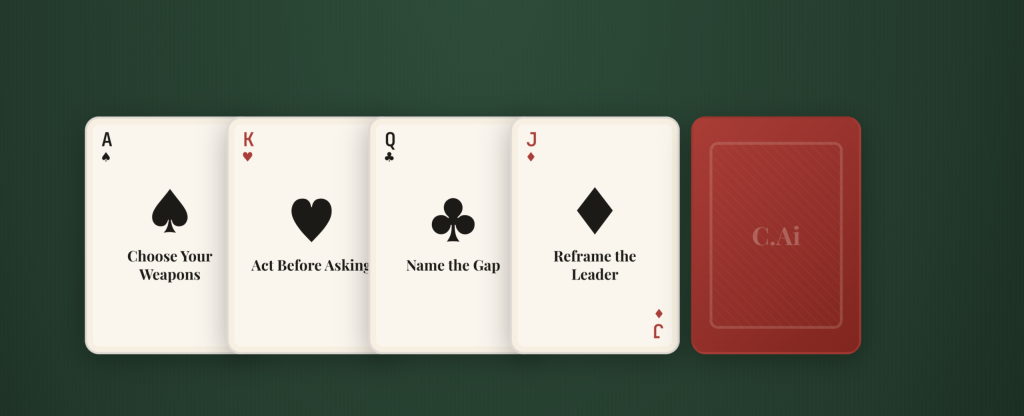
From a Real Conversation, Today
The Agency Hand:5 Cards Every Leader Wants Their Team to Play
Chrystina Balmer challenged me on five things today. She was right every time. Here’s why that’s the most valuable thing a team member can do.
I just got off a call with Chrystina Balmer, our program manager at Collaboration.Ai. In 45 minutes, she challenged my tool choices, invested in company infrastructure without my sign-off, surfaced a structural problem I’d been ignoring, told me where I should and shouldn’t show up, and freed leadership from work we shouldn’t be doing.
That’s not insubordination. That’s agency. And it’s the single trait I’d hire for above everything else.
Harvard Business Review calls it constructive dissent. McKinsey says it produces better decisions. I call it playing your hand.
A
Card 1: Tool Stubbornness
Choose Your Own Weapons
I’m all-in on Claude. I’ve built our entire content engine on it. When I told Chrystina, she didn’t flinch. She’s built a full program management system in ChatGPT, and she’s not switching because her boss has a preference.
That’s not stubbornness. That’s a professional who evaluated the tools and made her own call.
“I’ve got my whole project management setup in ChatGPT. The exports don’t maintain the same functionality in Claude.”
Chrystina Balmer, during our call today
The best people don’t wait for leadership to hand them a tool. They pick what works. They test. They commit. And they’ll defend that choice with evidence.
PwC 2025 Workforce Survey
Employees who choose their own AI workflows report higher productivity and engagement. Tool autonomy is now a retention factor, not a perk.
Gartner Future of Work 2026
Gartner identifies “tool autonomy” as a defining workplace trend. The companies losing talent are the ones mandating a single stack.
K
Card 2: Independent Action
Act Before Asking
Chrystina and the team invested in and overhauled our CRM system. Did I approve it? Sort of. Do I trust them? Sort of. Do I love every decision they made? No. Is it going to be awesome and help our company grow beyond the founder being the only one who can sell? Yes.
That’s the tension every leader has to sit with. The alternative is worse: a team that won’t update a system, choose a vendor, or commit budget without a Slack message to the boss. I’ve seen that at Fortune 100 companies. Dozens of people, frozen, waiting for one person to say “go.” Nothing ships. Nothing changes.
“We invested in the CRM and restructured how we track accounts. It’s going to change how we grow.”
Chrystina Balmer, on the team’s independent investment decision
Harvard Business Review, Feb 2025
Constructive dissent unlocks innovation by reducing groupthink and forcing teams to examine assumptions. The research: diverse action produces better outcomes than perfect consensus.
MIT Sloan Management Review
Five ways leaders turn pushback into progress. The key insight: pushback is data. Leaders who treat it as insubordination lose their best signal.
Q
Card 3: Structural Honesty
Name the Gap Nobody Wants to Name
Chrystina surfaced something I’d been stepping around: one team in our company documents extensively but doesn’t share well with another team that’s working the same accounts. Both of us independently built the same background research on a client. That’s not a “communication issue.” It’s a structural gap that leadership owns.
She didn’t just complain about it. She identified where the system breaks and pointed the accountability upward. That takes guts. Most people just duplicate the work and stay quiet.
“We both built the same client research separately. One team documents everything, but there’s no visibility across groups.”
Chrystina Balmer, on the structural gap between teams
Harvard Business Review, Aug 2023
When employees speak up, they circulate local knowledge, expand useful ideas, and prevent collective tunnel vision. When they don’t? Preventable mistakes go unchecked.
Harvard Business Impact
Psychological safety is the hidden engine behind innovation. Teams where it’s safe to name problems outperform teams that sweep them under the rug. Every time.
The Joker Isn’t Wild. The Joker Is Strategic.
Chrystina is building a presentation for our 50-person all-hands where she wants to position leadership as “jokers” in the team’s poker hand. Not wild cards. Strategic plays to be deployed at the right moment, not sitting at every table.
That takes real courage. Telling your founder he’s a card to be played, not the dealer.
J
Card 4: Role Reframing
Reframe the Leader’s Role
Chrystina asked to take over a section of our 50-person all-hands call. Her plan? A poker hand metaphor. Each team member is a card with a specific role. Leadership? We’re the jokers. Not because we’re unpredictable, but because we’re high-value plays that should be used strategically, not defaulted to.
Think about what that means. She’s telling the entire company: “Stop running everything through the founder. He’s a closer, not an operator. Play him when it counts.”
“Leadership are the jokers. You play them strategically, not at every hand.”
Chrystina Balmer, pitching her section of the upcoming all-hands
Harvard Business Review, Dec 2025
How to push back against your CEO’s bad decision. The finding: teams that reframe leadership roles (rather than just following orders) produce better strategic outcomes.
McKinsey, People & Organizational Performance
Into all problem-solving, a little dissent must fall. Google formally designates “naysayers” on projects. The role: argue against any position, including the leader’s default.
10 Card 5: Time Protection
Protect the Leader’s Highest-Value Time
Chrystina identified the real bottleneck: leadership is too deep in operations to focus on where the company’s future actually lives. I’m the most obvious example, but it’s not just me. When any leader spends their day on marketing coordination, client deliverables, and internal operations, nobody’s building what comes next.
She didn’t wait for permission. She communicated a restructuring plan: one team member takes over marketing execution, another handles client outreach, the external agency narrows to design-only scope, and a part-time contractor picks up program support. All of this frees leadership’s calendar for the strategic work that actually moves the company forward.
“Leadership needs to be freed up for strategic work. You’re all too bogged down in operations right now.”
Chrystina Balmer, on restructuring the team to protect leadership’s time
SHRM, 2026 Workplace Research
Leadership is shifting from supervising rosters to stewarding networks. The best team members help their leaders make that shift, not wait for them to figure it out alone.
Harvard Business Review, Nov 2025
The surprising success of hands-on leaders comes with a counterpoint: knowing when NOT to be hands-on is the harder skill. The team that protects its leader’s focus protects the company.
People Helping People Framework
Where Does Agency Liveon the Pyramid of Impact?
At Collaboration.Ai, we measure how people help each other using a 10-level framework called the Pyramid of Impact. It starts at the bottom with small gestures (a nudge, a light introduction) and climbs to the top where someone orchestrates a full outcome for another person.
Most professional relationships hover between levels 1 and 4. You forward an article. You make an intro. You mention someone’s name in a meeting. That’s good, but it’s table stakes.
The real value starts at level 5 and above, where people invest real time, reputation, or resources into someone else’s success. That’s where agency lives. And that’s where Chrystina operated today. Not at the bottom of the pyramid, not making safe suggestions. She was at levels 6, 7, and 8, making strategic moves that changed how the company works.
10 Orchestrated Success
9 Platform Sharing
8 Co-Creation Card 4: All-Hands Poker Metaphor
7 Resource Deployment Card 5: Team Restructure
6 Strategic Counsel Card 3: Name the Gap
5 Active Advocacy
4 Warm Referral
3 Introduction
2 Light Touch
1 Nudge
3 Pyramid levels Chrystina hit today
5 Independent plays in 45 minutes
6+ Average service level (strategic counsel and above)
What Cards Is Your Team Playing?
If your team only plays when you deal, you don’t have a team. You have an audience. The best players pick up cards on their own.


