
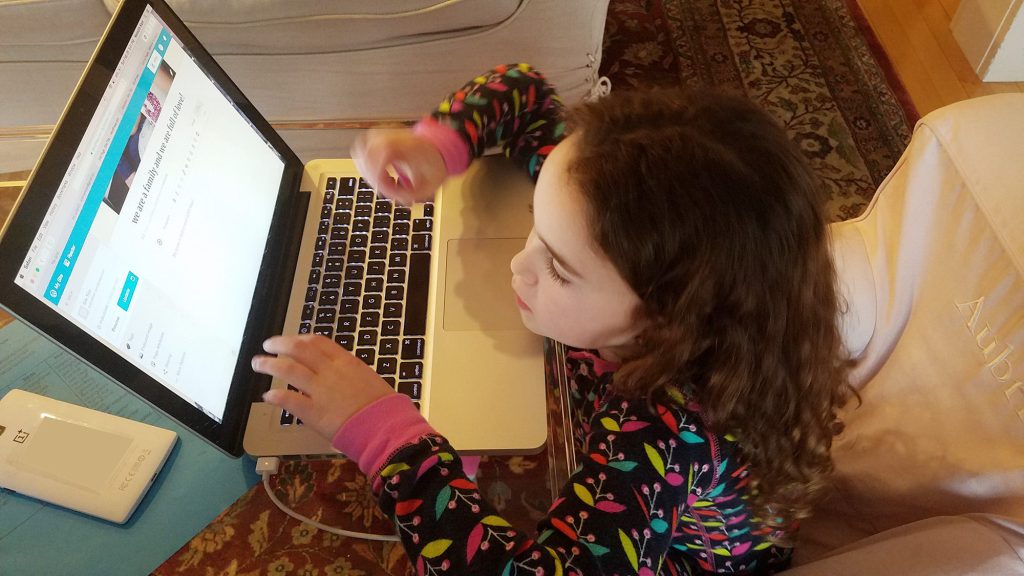
My daughter is in second grade. For her research project this quarter, she was tasked with creating and giving a presentation. Asking to borrow my wife’s old computer, she quickly began figuring out how to create a Keynote presentation — the biggest barrier being adjusting to the fact that it wasn’t a touch screen!
And, screeching halt: How could I let this happen?
While she was eagerly kicking off her career of formulating and visually presenting her ideas, it was shocking that 30+ years later, she was following the same linear presentation format, the same narrow thinking, void of creativity and questioning, that I was taught in grade school. As she headlined her next slide and excitedly read to me, verbatim: “The Giant Panda is an omnivore not an herbavore…” I realized that my parenting fears had melded with my perpetual corporate nightmare: I was being mired in PPT hell.
How could I let this happen? In everything that I have learned, read and regularly preach to my customers as an advanced collaborator, how could I let my daughter journey down the same narrow road that I know needs to diverge?
So, I did what any alarmed parent would do…I immediately stopped her. Her resistance, much tougher than many a seasoned executive, eventually yielded excitement (coerced by the promise of extra computer time) at the opportunity to learn how to do some good ol’ web searching. I showed her the vast world (or small subset that she could focus on) of options that could lead to a really interesting project including:
Cool presentation tools:
Canva
Haiku
Mind map thinking:
MindMeister
MindManager
Auto calculation tools:
Google Sheets plugin
RAW Graphs
Even a bit of Artificial Intelligence :
Google’s Drawing Neural Engine
Wordsmith to write for you
And, screeching halt.
She is 7. This assignment is meant to help her learn more about “Vertebrates of Asia” (her choice: The Giant Panda). Would she really learn more with the swirl of ideas that I just put in her head (for which we had yet to answer one question for her report) than if she had just continued with her PPT approach? So as she wrapped up her first work session, I continued pondering what would be best for her both for the project and the future of her learning:
What tools and methodologies would allow her to research smarter?
What guidance would help her to learn, and retain her learning, about The Giant Panda?
How could her learning extend beyond what she reads online…hearing from local people who live among Panda’s and bamboo forests ( I’m talking beyond the Como Zoo)
How could she become a great presenter of her ideas?
How could she, use and continue to seek out, advanced technologies to assist her?
Would it be possible for her to get feedback and iterate her work on the Panda before her presentation (corrections, i mean iteration, from parents doesn’t really count…does it?)
How could a simple Quarterly project inspire her and her classmates?
And, momentary reflection.
I am a dorky dad, who did purchase all my children’s domain’s after we settled on their names. Maybe this is the opportunity I’ve been waiting for, in which to introduce my daughter to the making of her digital identity. Could this be a key component in guiding the educational learning style that I want for her? Is she ready to begin learning of the opportunities and implications that come with publishing online…am I really ready to begin teaching her?
So, true to what my wife kindly refers to as my “obtuse” parenting style, I laid out my rules:
- She needed to consider my questions as she determined what to build
- She was ultimately responsible for doing the researching and selecting what and how she wanted to present
- She could not use the social sites until she is much older
Learnings I have noticed so far:
- Understands that web addresses work like the post office and there are different structures of determining how ‘things’ get from point A to point B.
- Ideas and feedback are much more well received when they show up as comments from friends and family around the world. A comment or recommendation is a delightful challenge verses another parental ‘judgement’.
- There is always a new ‘tab’ or source for searching and ideas.
- Words underlined in red intrigue her to learn more about the word itself, verses our generation’s inherent need to quickly auto-correct the spelling
- The Giant Panda study has morphed into research on birds, flying her to places she never considered….
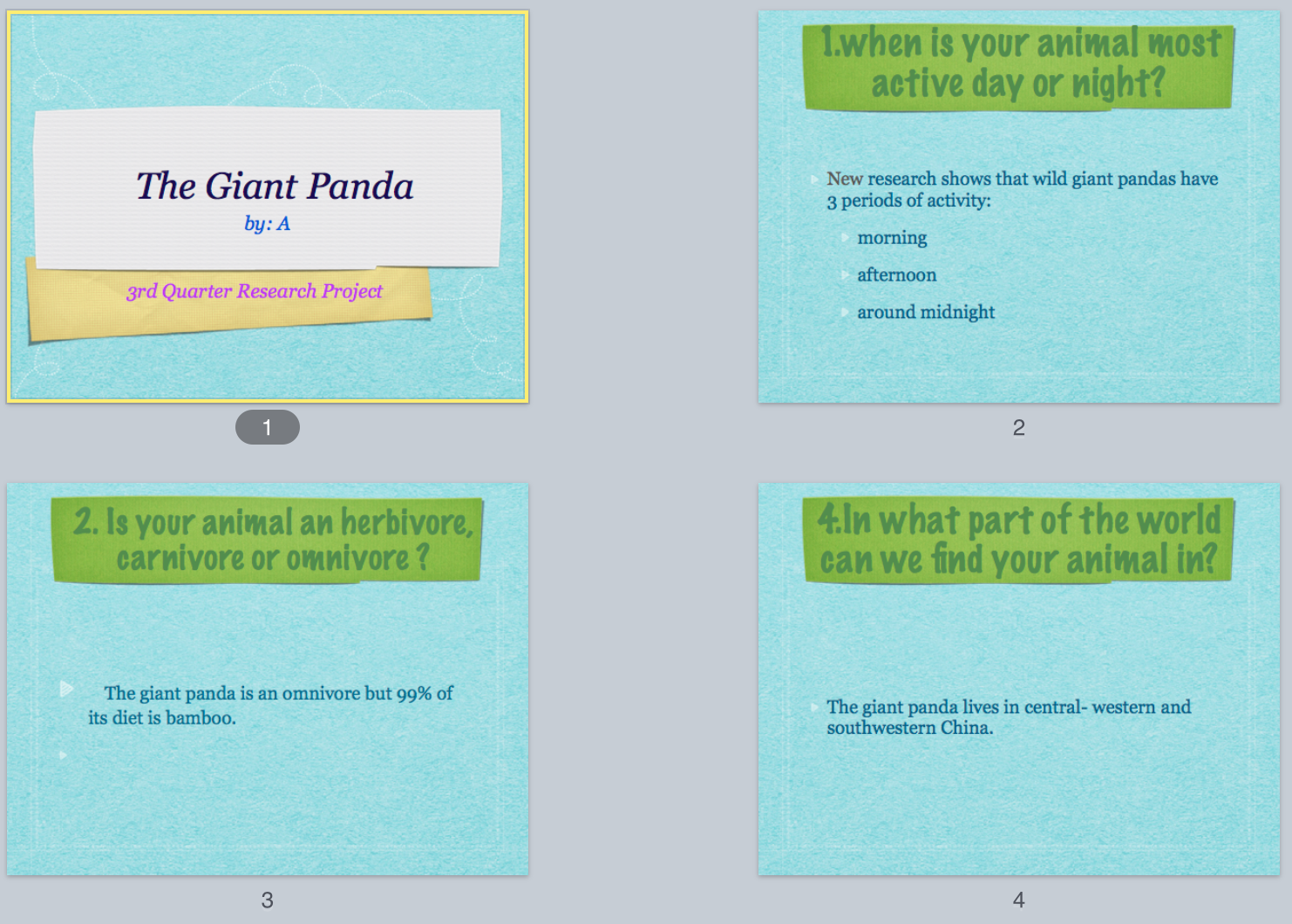
Here is where she started in Keynote:
Interested in seeing where her journey takes her or better yet, contributing to her learning and that of our future generations? Please DM me Brandon Klein
For the record:
- She is using WordPress with numbers plugins to get external learning — not just a static page.
- My day job is running an advanced collaboration software and services company. Collaboration.Ai and theDifference Consulting.


