
Originally posted on May 02, 2005 and updated by Brandon Klein on December 16, 2025.
Remember that meeting where your boss assigned tasks like a general deploying troops? Yeah, we’ve all been there. The command-and-control approach might get stuff done, but it kills the one thing that makes knowledge work actually work: people giving a damn.
Here’s the uncomfortable truth about self-organizing teams that most management books won’t tell you: they’re messy, unpredictable, and absolutely outperform traditional hierarchies when you get them right. I’ve watched teams transform from clock-punching zombies to passionate problem-solvers simply by changing how work gets chosen, not assigned.
The Problem with Playing General
Industrial Age thinking treats workers like cogs. You slot them in, tell them what to do, and expect consistent output. This works great if you’re making widgets. For knowledge worker management, it’s like using a hammer to perform brain surgery.
When you dictate every move, you get compliance, not commitment. People do exactly what you ask—nothing more, nothing less. They save their creativity for their side hustles and weekend projects.
How Self-Organization Actually Works
Forget the management speak. Self-organization is simple: smart people who understand the goal will figure out better ways to reach it than any manager could prescribe. But there’s a catch—you need to set them up for success.
Create the Context, Not the Commands
Start with alignment. Everyone needs to understand:
- What success looks like
- Why it matters
- What resources they have
- What constraints exist
Then step back. Let teams choose their approach, their partnerships, and their pace. This isn’t abdication—it’s workplace autonomy with accountability.
The “Vote with Your Feet” Principle
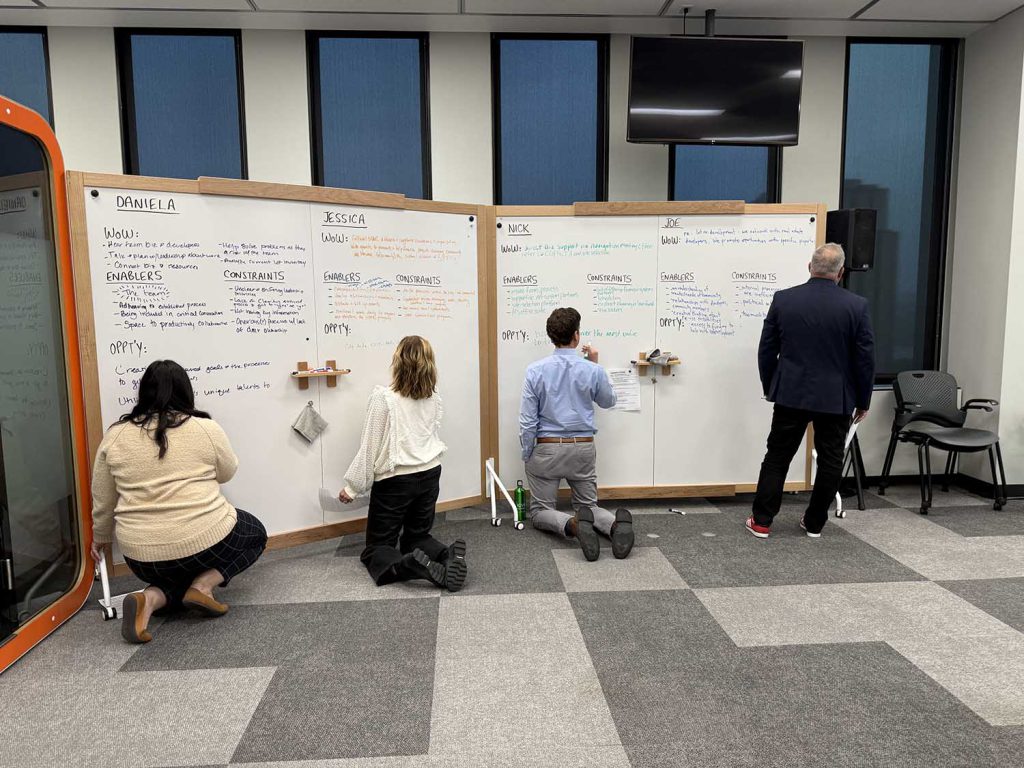
Here’s a radical idea that works: let people choose what they work on. During planning sessions, present the challenges and let team members gravitate toward what excites them. You’ll find that passion beats assignment every time.
I’ve seen this play out hundreds of times. Give someone a book to read for an hour and ask them to find a message relevant to your project. They’ll discover insights you never could have assigned. This principle echoes what Liberating Structures teaches about distributed control—when everyone has a voice in what they work on, engagement naturally follows.
Why This Works: The Science Behind Self-Organization
Complexity theory shows us that intelligent systems self-organize better than they can be organized. Think about ant colonies—no ant has the master plan, yet they build incredible structures through simple rules and local interactions.
Knowledge work operates the same way. When you trust your team’s collective intelligence instead of commanding from above, you tap into employee empowerment that creates solutions no single mind could conceive. Amy Edmondson’s research on psychological safety reinforces this—teams need to feel safe to experiment and self-organize effectively.
The Trust Factor
This approach requires genuine trust. Not the corporate poster kind—the real kind where you believe your people will do the right thing without supervision. Most managers say they trust their teams but still hover like helicopter parents.
Making It Real: From Theory to Practice
Start small. Pick one project and try these steps:
- Define the outcome, not the process. Say “we need to reduce customer complaints by 30%” not “follow this 47-step plan.”
- Let teams form organically. Present the challenge and let people choose to join based on interest and skills.
- Create feedback loops, not checkpoints. Regular sharing sessions beat status reports every time.
- Celebrate experiments, including failures. Learning happens at the edges of comfort zones.
These practices align with what modern workshop facilitators are discovering about collaborative leadership—the best outcomes emerge when you create space for collective intelligence rather than commanding from the front.
The Cognitor Angle: Amplifying Self-Organization with AI
Here’s where it gets interesting. A Cognitor approach would deploy AI agents to amplify self-organization:
- Pattern Recognition Agents analyze team dynamics and suggest optimal configurations based on past performance data
- Context Synthesis Agents continuously update shared understanding by processing all team communications and highlighting emerging themes
- Resource Matching Agents connect people with exactly the tools, knowledge, and contacts they need in real-time
- Learning Amplification Agents capture lessons from every experiment and make them instantly available across the organization
This isn’t about replacing human judgment—it’s about giving self-organizing teams superpowers to organize even more effectively. As IBM’s research on agentic workflows shows, AI can enhance rather than replace human agency in complex work environments.
The Bottom Line
People will always ask more of themselves than you can ask of them—if you create the right conditions. Stop trying to control every variable. Instead, focus on organizational culture that trusts people to figure things out.
The future of work isn’t about better command structures. It’s about creating environments where creativity and innovation emerge naturally from engaged people solving real problems together. That’s not just good leadership strategy—it’s the only strategy that makes sense in a world that changes faster than any hierarchy can adapt. Leading innovators are already transforming how teams collaborate, moving away from traditional hierarchies toward more dynamic, self-organizing structures.
Want to try this? Start tomorrow. Pick your smallest team and your gnarliest problem. Share the challenge, step back, and watch what happens. You might just discover that the best way to manage knowledge workers is to stop managing and start enabling.


