
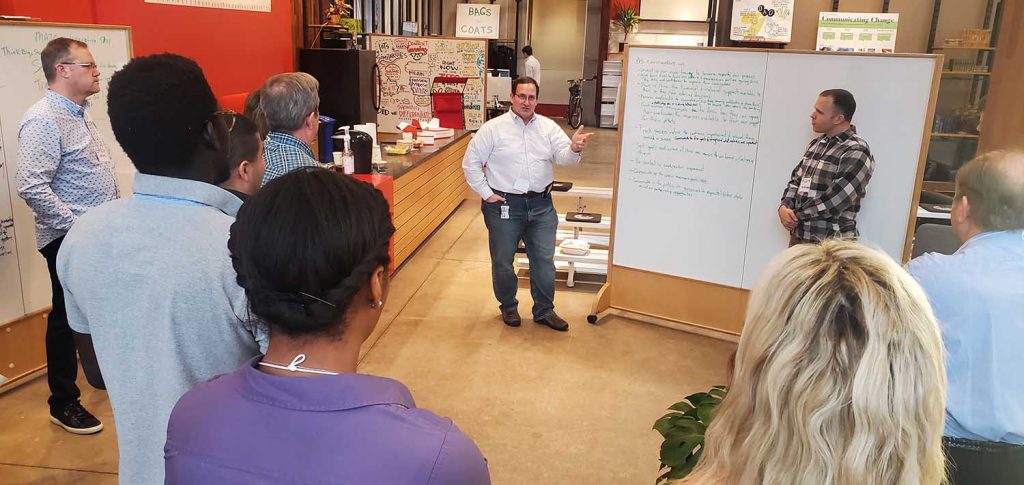
Ever walked into a workshop where everyone’s just going through the motions? You know the drill – polite nodding, surface-level answers, and that awkward silence when the facilitator asks “Any questions?” Well, here’s a tool that’ll blow that tired format out of the water: Take-A-Panel exercises.
I’ve been running workshops for two decades, and let me tell you, nothing gets people fired up quite like a well-crafted Take-A-Panel session. It’s the difference between watching a boring documentary and being thrown into an escape room – suddenly everyone’s engaged, thinking critically, and actually enjoying the process.
What the Hell is a Take-A-Panel Exercise?
Think of Take-A-Panel as speed dating meets expert interrogation. Instead of death by PowerPoint, you’re creating a dynamic environment where participants become investigative journalists, grilling a panel of “experts” who are role-playing key stakeholders in whatever organizational change or merger integration you’re tackling.
Here’s the kicker: these aren’t real experts. They’re participants who’ve been briefed to embody specific perspectives – maybe the CEO who championed a merger, the middle manager dealing with channel conflict, or the customer service rep watching everything change around them. The magic happens when the “audience” starts asking tough questions and the panelists have to think on their feet.
Why Take-A-Panel Works When Everything Else Falls Flat
Most facilitation techniques treat participants like passive receivers of wisdom. Take-A-Panel flips that script entirely. When you’re forced to embody someone else’s perspective and defend their decisions under fire, something incredible happens – you actually start understanding the complexity of organizational change at a gut level.
I remember running a session for a healthcare company going through a massive merger integration. We had one participant playing the role of the acquiring company’s CEO, getting grilled about synergy targets. Watching them squirm while trying to justify headcount reductions they didn’t personally agree with? That’s when the lightbulb moments started happening. People began to see beyond their own silos and understand the brutal trade-offs involved in organizational change.
The Anatomy of Killer Take-A-Panel Questions
The secret sauce is in the questions. You can’t just wing it with “So, how’s the merger going?” You need questions that cut to the bone, that force panelists to grapple with real tensions and contradictions. Here’s what separates amateur hour from professional-grade facilitation:
Questions That Expose Hidden Tensions
- For merger scenarios: “Two decisions you made along the way threatened the success of this project. What were they and how did you correct them?” This forces honesty about mistakes rather than corporate cheerleading.
- For channel conflict: “What aspects of your culture had to change to overcome channel conflict? What sacred cows did you have to slaughter?”
- For leadership strategies: “Looking back, what do you wish you had known three years ago when this whole process started?”
Questions That Demand Specificity
Vague answers are the enemy of insight. Your questions should force panelists to get granular:
- “How did you measure the merger’s progress and performance? Give me actual metrics, not buzzwords.”
- “Walk me through your decision-making process during the transition. Who had veto power? How long did decisions take?”
- “What was your personal contribution to the success of this effort? Not your team’s – yours specifically.”
Setting Up Your Take-A-Panel for Maximum Impact
Here’s where most facilitators screw up – they treat Take-A-Panel like a nice-to-have add-on instead of the main event. If you want this to work, you need to commit fully. That means:
1. Brief Your Panelists Like Their Lives Depend On It
Give each panelist a detailed character sheet. Not just “You’re the CFO” but “You’re the CFO who initially opposed the merger but changed your mind when you saw the synergy achievement potential. You’re proud of the cost savings but worried about cultural integration.” The more specific the backstory, the more authentic the responses.
2. Create Real Stakes
Tell the audience they’re consultants hired to evaluate whether the merger was successful. Or they’re board members deciding whether to greenlight the next acquisition. When people have a role to play beyond “workshop participant,” they lean in hard.
3. Use the Physical Space
Don’t just put panelists behind a table. Create a courtroom vibe. Have the audience stand when asking questions. Move panelists to a “hot seat” for tough questions. The physicality matters more than you think.
Real-World Take-A-Panel Scenarios That Deliver Results
Let me share some battle-tested scenarios that consistently generate breakthrough insights:
The Merger Post-Mortem
Perfect for companies going through merger integration. Panelists play key stakeholders three years after a merger, explaining what worked and what didn’t. Questions focus on cultural clashes, supply chain optimization challenges, and unexpected synergies. This scenario helps current merger teams anticipate problems before they happen.
The Channel Conflict Resolution
Ideal for companies struggling with channel conflict management. Panelists represent different channels (direct sales, partners, online) explaining how they moved from competition to collaboration. Questions probe the dirty details of territory disputes and commission structures.
The Customer Service Transformation
Great for customer service improvement initiatives. Panelists play leaders who transformed a broken service organization. Questions focus on technology choices, training approaches, and measuring success beyond traditional metrics.
Common Pitfalls and How to Avoid Them
I’ve seen Take-A-Panel sessions crash and burn. Here’s how to avoid the most common failures:
The Softball Problem
When audiences ask easy questions, the whole exercise becomes pointless. Combat this by planting a few “assassin” questioners with pre-written hardball questions. Once they model aggressive questioning, others follow suit.
The Know-It-All Panelist
Sometimes a panelist goes rogue, making up details that don’t fit the scenario. Have a facilitator “fact-checker” who can intervene with “Actually, according to the scenario, that decision was made by the board, not you. How did you influence it?”
The Time Crunch
Take-A-Panel needs time to build momentum. Budget at least 90 minutes, preferably 2 hours. The first 20 minutes are always awkward – push through. The gold comes later.
Advanced Techniques for Experienced Facilitators
Once you’ve mastered the basics, try these advanced moves:
The Timeline Twist
Run multiple panels representing different time periods. Panel 1 is pre-merger, Panel 2 is six months in, Panel 3 is two years later. The evolution of perspectives is eye-opening.
The Opposition Panel
Create two panels with opposing views on the same initiative. Let them debate directly. The cognitive dissonance forces participants to think more deeply about trade-offs.
The Customer Panel
Include panelists playing customers affected by the change. Nothing sharpens thinking like hearing “your” decisions through the customer lens.
Measuring Success: How to Know Your Take-A-Panel Worked
Forget happy sheets. Here’s how you know a Take-A-Panel session actually moved the needle:
- Language changes: Participants start using more nuanced language about the challenge. Black-and-white thinking gives way to shades of gray.
- Questions improve: In subsequent discussions, participants ask better questions – ones that show they understand complexity.
- Sacred cows get questioned: Previously untouchable assumptions suddenly become fair game for discussion.
- Energy shifts: The room feels different. People are leaning forward, interrupting each other (productively), drawing connections.
Integrating Take-A-Panel with Other Facilitation Methods
Take-A-Panel isn’t a standalone tool – it’s part of a broader facilitation ecosystem. Here’s how it fits with other approaches:
Before Take-A-Panel
Use syntopical reading exercises to give participants background on the scenario. Run a SWOT analysis to identify key tensions that questions should probe.
After Take-A-Panel
Follow up with synthesis conversations to process insights. Use action templates to convert revelations into concrete next steps.
The Digital Evolution: Take-A-Panel in Virtual Settings
COVID forced us all online, and guess what? Take-A-Panel actually works better virtually in some ways. Breakout rooms become interrogation chambers. Chat becomes a backchannel for audience members to share reactions. The key is using technology to enhance rather than replicate the in-person experience.
I’ve found success using tools like MURAL for visual note-taking during sessions, allowing the audience to see patterns emerging in real-time. The digital format also enables recording, so teams can revisit crucial moments of insight later.
The Psychology Behind Why This Works
Take-A-Panel taps into fundamental psychological principles that most facilitation ignores:
Perspective-Taking
When you force someone to defend a position they don’t hold, they develop empathy for that position. It’s like method acting for business problems.
Social Pressure
Being on the hot seat creates productive stress. Panelists can’t phone it in when facing a room full of skeptical questioners.
Narrative Construction
Humans understand complex situations through stories. Take-A-Panel forces participants to build and defend narratives, making abstract concepts concrete.
Case Study: How One Company Used Take-A-Panel to Save a Failing Transformation
A global tech company was 18 months into a digital transformation that was going nowhere. Morale was in the toilet, budgets were blown, and the board was asking hard questions. Traditional workshops had produced nothing but PowerPoints and platitudes.
We ran a Take-A-Panel with panelists playing the transformation team five years in the future, explaining how they turned things around. The questions were brutal: “Why did you waste $50 million on the wrong platform?” “How did you convince the skeptics in operations?”
The session surfaced issues no one had been willing to discuss: the transformation leader’s lack of technical knowledge, the procurement team’s risk aversion, the unspoken competition between divisions. More importantly, by forcing panelists to explain how they “solved” these problems, the group generated actual solutions.
Six months later, the transformation was back on track. The CEO credited the Take-A-Panel session as the turning point, saying it was the first time his team had “told the truth about what was really happening.”
Your Next Steps: Implementing Take-A-Panel
Ready to try this yourself? Here’s your playbook:
- Start small: Run a 45-minute mini-panel in your next team meeting. Pick a current challenge and have three people role-play key stakeholders.
- Prepare thoroughly: Spend twice as long preparing scenarios and questions as you’ll spend running the session. The prep work is where the magic happens.
- Embrace discomfort: The first 15 minutes will feel awkward. Push through. Breakthrough happens on the other side of discomfort.
- Document insights: Assign someone to capture the “aha” moments. They’ll come fast and furious once the session heats up.
- Follow through: Don’t let insights die in the room. Build your next steps directly from what emerges in the panel.
The Bottom Line
Take-A-Panel isn’t just another facilitation technique – it’s a way to make organizational challenges visceral and personal. When people stop talking about “the company” and start saying “when I was facing that decision,” you know you’ve broken through.
In an era where every company faces constant disruption, change management isn’t a nice-to-have – it’s survival. Take-A-Panel gives you a way to practice handling complex challenges before they become expensive mistakes. It turns theoretical discussions about stakeholder communication and business model adaptation into lived experiences that stick.
The beauty of Take-A-Panel is its flexibility. Whether you’re dealing with a gnarly merger integration, trying to resolve channel conflict, or figuring out supply chain optimization, this approach forces people to grapple with real complexity instead of hiding behind buzzwords and best practices.
So next time you’re planning a workshop and dreading another round of breakout groups and report-backs, consider throwing your participants into the hot seat instead. You might be surprised by what emerges when people stop being polite and start getting real about the challenges of organizational change.
Remember: the goal isn’t to make people comfortable. It’s to generate insights that actually move the needle. Take-A-Panel does that by making the abstract concrete, the theoretical personal, and the complex understandable. In a world drowning in frameworks and methodologies, sometimes what we need most is to simply step into someone else’s shoes and see how the world looks from there.
Now stop reading and start planning your first Take-A-Panel session. Your next breakthrough is waiting on the other side of those tough questions.


