Originally posted on February 11, 2011 and updated by Brandon Klein on December 1, 2025.
Let’s be real – running meetings can be a soul-crushing experience. You know the drill: endless PowerPoint presentations, people checking their phones, and that one person who dominates every discussion while others sit silently. But what if I told you there’s a way to run meetings where people actually want to participate, where the best ideas naturally rise to the surface, and where you can tackle complex problems without the usual corporate theater?
Enter Open Space Technology (OST) – a meeting format that throws out the rulebook and lets participants drive the entire agenda. And when you combine OST with AI agents (Cognitors), you’re not just running a meeting; you’re orchestrating a knowledge-generation machine that captures, synthesizes, and transforms every insight in real-time.
What Open Space Technology Actually Is (Without the Fluff)
Open Space Technology is deceptively simple: gather people who care about a topic, let them create the agenda on the spot, and watch magic happen. No pre-planned sessions, no designated speakers, no rigid timelines. Just passionate people organizing themselves around what matters most.
Here’s how it works in practice:
- Opening Circle: Everyone sits in a circle (yes, actually). The facilitator explains the theme and the rules.
- Marketplace of Ideas: Participants write session topics on paper, announce them to the group, and post them on a wall.
- Self-Organization: People choose which sessions to attend based on their interests.
- Concurrent Sessions: Multiple discussions happen simultaneously in different spaces.
- Closing Circle: Everyone reconvenes to share key insights and next steps.
The Four Principles That Make OST Work
- Whoever comes is the right people – Stop worrying about who’s missing. The people who show up are exactly who need to be there.
- Whatever happens is the only thing that could have – Let go of predetermined outcomes. Trust the process.
- When it starts is the right time – Creative inspiration doesn’t follow a schedule.
- When it’s over, it’s over – Don’t drag things out. When energy dissipates, move on.
The Law of Two Feet (Your Secret Weapon)
This is where OST gets radical: if you’re not learning or contributing, use your two feet and go somewhere else. No guilt, no judgment. This single rule transforms meeting dynamics by ensuring everyone is exactly where they want to be.
Adding Cognitors: Where Human Creativity Meets AI Intelligence
Now here’s where it gets interesting. Imagine running an Open Space session where AI agents (Cognitors) work alongside humans to:
- Capture Everything: Real-time transcription and semantic mapping of every conversation
- Synthesize Patterns: Identify common themes across concurrent sessions
- Generate Artifacts: Transform discussions into actionable documents, prototypes, or strategic plans
- Bridge Knowledge Gaps: Pull in relevant research, case studies, or expert insights on-demand
This approach builds on emerging trends in AI-powered facilitation and design thinking, where technology amplifies human creativity rather than replacing it.
Real Example: Strategic Planning at Scale
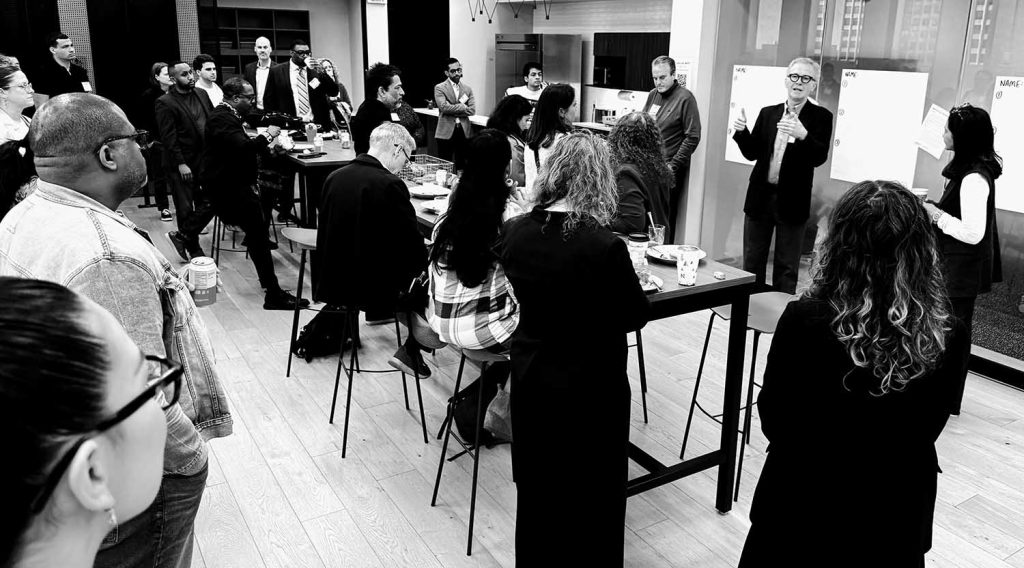
Last month, I facilitated an OST session for a 500-person organization facing digital transformation. We deployed Cognitors to:
- Monitor 25 concurrent breakout sessions
- Create real-time knowledge graphs showing idea connections
- Generate executive summaries every 30 minutes
- Produce a comprehensive transformation roadmap by session end
Result? What typically takes months of committee meetings was accomplished in 4 hours, with higher engagement and better outcomes.
How to Run Your First Cognitor-Enhanced OST Session
Pre-Session Setup (1 Hour)
- Deploy capture agents for audio/video recording
- Configure real-time transcription services
- Set up collaborative digital walls for topic posting
- Brief participants on both OST principles and AI capabilities
For those interested in the science behind effective collaboration, recent neuroscience studies have shown how group dynamics affect brain function, providing insights that inform both OST design and AI integration strategies.
During the Session
- Human Facilitators: Guide the process, hold space, manage energy
- AI Cognitors: Capture, analyze, synthesize, and visualize in real-time
- Participants: Focus purely on creative problem-solving
The effectiveness of this approach is supported by research from Harvard Business Review on collaborative intelligence, which demonstrates how human-AI partnerships outperform either working alone.
Post-Session Magic
Within 15 minutes of closing circle, Cognitors deliver:
- Searchable transcripts of all sessions
- Visual maps of idea relationships
- Prioritized action items with owner assignments
- Draft project plans based on discussion outcomes
This rapid synthesis capability addresses a key challenge in traditional collaboration – the gap between ideation and implementation. As we’ve explored in our analysis of why collaboration goes beyond simple communication tools, true collaboration requires systems that capture and transform collective intelligence.
Common Pitfalls and How to Avoid Them
- Over-controlling the process: Trust is everything. Let chaos lead to order.
- Ignoring technical setup: Test your Cognitor stack beforehand. Nothing kills energy like tech failures.
- Forgetting human connection: AI enhances but doesn’t replace human facilitation.
- Analysis paralysis: Don’t let AI insights overshadow human intuition.
The Open Space Technology official website provides additional resources and case studies for those looking to dive deeper into the methodology.
The Bottom Line
Open Space Technology already revolutionizes how groups tackle complex challenges. Add Cognitors to the mix, and you’re not just running better meetings – you’re creating knowledge-generation engines that transform how organizations think, learn, and evolve.
Stop wasting time in meetings that drain souls and produce nothing. Start creating spaces where human passion meets AI intelligence, where the best ideas win regardless of hierarchy, and where a morning’s work can transform an entire organization.
Ready to try it? Start small. Pick a thorny problem, gather 20-30 people who care about solving it, set up basic Cognitor support, and watch what emerges. I guarantee it’ll change how you think about collaborative work forever.